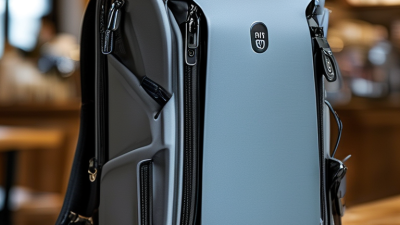

China’s business-backpack suppliers offer global buyers a wide range of styles, materials, and charging features. Yet a built-in USB port is not a power source. It connects an external power bank to a reachable outlet, so buyers should check cable routing, pocket access, and power-bank compatibility before placing an order.
The market context is broader than backpacks alone. GSMA’s The Mobile Economy 2024 reports that 5.6 billion people subscribed to mobile services in 2023, underscoring how central connected devices have become. Grand View Research’s luggage-market analysis tracks demand across travel bags, but neither report isolates USB-equipped business backpacks as a separate category. That gap matters. Buyers should verify product claims directly through samples, specifications, and supplier documentation—not assume category-level trends prove an individual bag’s quality.
Industrial designer Dieter Rams offered a useful standard: “Good design is as little design as possible.” His principle was not written specifically for backpacks, but it applies well here. A useful business backpack should protect a laptop, keep documents organized, and make charging access practical without adding awkward bulk. Not always easy. For this China-focused top-10 guide, we compare visible construction details, compartment layout, materials, comfort, customization options, and the clarity of each product’s charging setup. One caveat: online specifications can look convincing, while a stiff zipper or poorly placed cable becomes obvious only in use. Buyers should request current samples and confirm details before committing.
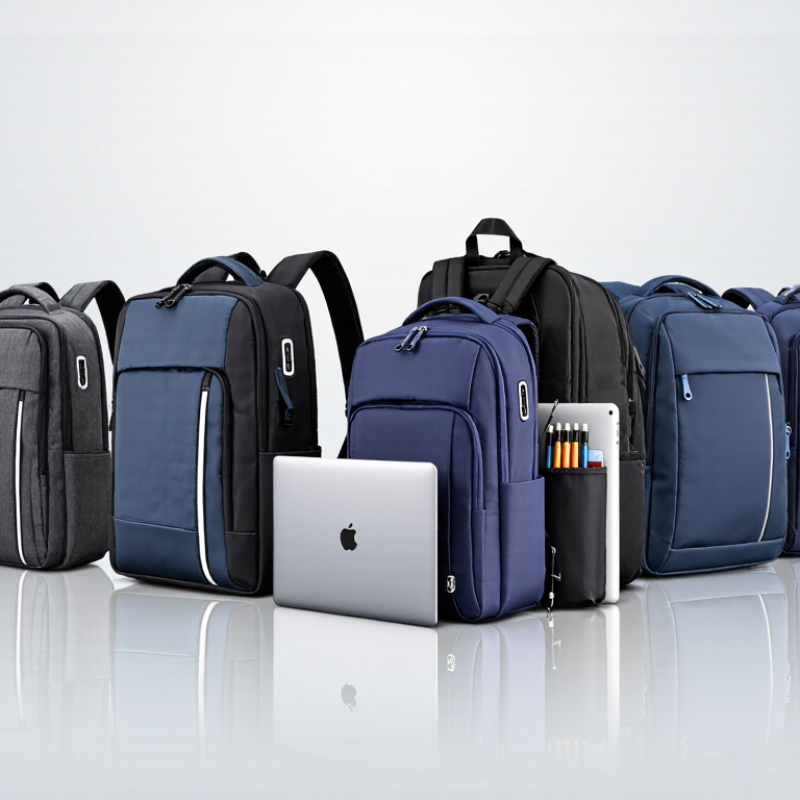
A USB business backpack is a work bag with a cable pass-through or built-in charging interface. Most models do not generate power. A user connects an external power bank inside the bag, then plugs a phone into the outside port. Simple, but easy to misunderstand.
China’s product range includes slim commuter packs, expandable laptop bags, water-resistant travel backpacks, and structured models for business trips. Common details include padded laptop sleeves, cable-routing pockets, trolley straps, and separate compartments for chargers. Materials vary from polyester and recycled fabrics to coated textiles. Stitching and zippers matter as much as the USB port. Grand View Research valued the global backpack market at USD 18.5 billion in 2023 and projected 6.8% annual growth through 2030. This broad market figure is not specific to USB business backpacks, but it signals steady demand.
Check the electrical setup carefully. Many bags provide only a passive USB cable, so charging speed depends on the power bank, cable, and phone. USB-IF states that USB Power Delivery 3.1 can support up to 240 watts with compatible equipment; that does not mean a backpack port can handle that output. Ask suppliers for port diagrams, material specifications, and sample testing results. Also test access while wearing the bag. A port can look convenient in photos and still sit awkwardly under a shoulder strap.
Option 1 is a slim 18-litre pack with a padded 15-inch laptop sleeve, polyester shell, and bar-tacked stress points. Option 2 offers 25 litres and a 16-inch compartment, but its heavier fabric may feel warm on crowded commutes. Option 3 uses a lightweight nylon body and fits a 14-inch laptop; inspect the zipper tracks before buying. Option 4 adds a 28-litre main compartment for chargers and documents, though loose items can shift without organizers. Each includes an external USB port connected to an internal cable; the power bank is usually separate.
Option 5 has a structured 20-litre shape, a 15-inch sleeve, and a reinforced base for setting it on hard floors. Option 6 stretches to 30 litres and fits larger laptops, but check its empty weight. Option 7 uses coated fabric and sealed-looking seams for light rain; that does not guarantee waterproofing. Option 8 has a compact 16-litre profile for a 13-inch device, with less room for bulky headphones. Option 9 pairs a 24-litre capacity with a suspended 15-inch sleeve and double-stitched handles. Option 10 prioritizes a firm frame and 16-inch fit, but may be awkward under an airplane seat. Small, but useful.
Compare sleeve measurements with the laptop itself, not just the advertised screen size. Feel the back panel, test loaded zippers, and check whether the USB cable stays accessible. Construction varies between batches, so photographs alone can miss uneven stitching. A larger capacity is not always better.
Buyer reference: These are representative specification profiles commonly found in the business-backpack market, not verified specifications for specific models. Confirm dimensions, materials, test results, and customization details with the supplier before ordering. A USB port is typically a pass-through connection for a buyer-supplied power bank; it does not itself include a battery.
| Option | Typical Capacity | Laptop Fit | Common Main Material | Typical Construction | USB Configuration | Business-Use Features | Buyer Checks |
|---|---|---|---|---|---|---|---|
| 1. Slim Commuter | 18–22 L | Up to 15.6 in; check device dimensions | 600D polyester | Padded laptop sleeve, simple lined compartments, reinforced stress points | External USB-A port with internal cable; power bank not included | Lightweight profile, document pocket, trolley sleeve on some versions | Confirm sleeve padding and whether the stated laptop size refers to screen size or actual fit dimensions. |
| 2. Everyday Work Backpack | 22–26 L | Up to 15.6 in | 600D or 900D polyester | Two-compartment layout, padded back panel, bound internal seams | External USB-A port with internal pass-through cable | Organiser panel, side pockets, padded shoulder straps | Request fabric composition, coating details, zipper specifications, and loaded-carry test information. |
| 3. Expandable Business Pack | 24–30 L, depending on expansion | Up to 15.6 in; some layouts accommodate larger devices | Polyester, commonly 600D–900D | Expandable gusset, zippered main compartment, reinforced base | External USB-A port; internal cable routing may vary | Extra packing space for short trips, document section, luggage pass-through | Check expanded dimensions, usable capacity, and whether expansion affects the laptop compartment. |
| 4. Large Laptop Backpack | 26–32 L | Up to 17 in, subject to device measurements | 900D polyester or polyester blend | Oversized padded laptop compartment, structured back panel, reinforced handle | External USB-A port; power bank stored separately inside | Room for charger and work accessories, multiple internal pockets | Ask for the laptop sleeve’s internal width, height, and depth; “17-inch” fit is not standardized. |
| 5. Water-Resistant Urban Pack | 20–26 L | Up to 15.6 in | Coated polyester or polyester with a water-resistant finish | Water-resistant zipper design may be available; seams are generally not fully waterproof unless specified | External USB-A port with pass-through cable | Suitable for everyday commuting and light rain when properly finished | Distinguish water-resistant fabric from a waterproof bag; request test method and results if a rating is claimed. |
| 6. Lightweight Nylon Pack | 18–24 L | Up to 15.6 in | Nylon or nylon-polyester blend; denier varies by specification | Lightweight panels, padded sleeve, bartack reinforcement at selected load points | External USB-A port; cable and port placement vary | Lower carry weight, compact profile, suitable for daily transit | Confirm fabric denier, lining, colorfastness, and actual empty-bag weight. |
| 7. Travel-Ready Work Backpack | 28–35 L | Up to 17 in in selected layouts | 900D polyester or nylon blend | Clamshell-style opening may be offered; padded laptop section and reinforced grab handle | External USB-A port with internal pass-through cable | More space for clothing and work gear, often includes a trolley sleeve | Check carry-on dimensions for target routes, compartment layout, and loaded seam strength. |
| 8. Recycled-Fabric Business Pack | 20–26 L | Up to 15.6 in | Recycled polyester, if documented by the supplier | Similar construction to standard polyester packs; recycled content depends on the fabric specification | External USB-A port; power bank not included | Can support recycled-material sourcing requirements when traceability is provided | Request evidence for recycled-content claims, applicable certifications, and material traceability. |
| 9. Structured Executive Pack | 20–27 L | Up to 15.6 in | High-density polyester, nylon, or a blended outer fabric | More structured body, padded laptop sleeve, reinforced top handle, lined organiser pockets | External USB-A port; internal cable routing is configuration-dependent | Neater presentation, dedicated document storage, stable shape when lightly loaded | Inspect edge finishing, lining attachment, zipper operation, and handle reinforcement on a production sample. |
| 10. Customizable Corporate Pack | 20–30 L, depending on design | Commonly 15.6 in; larger sleeves may be specified | Polyester, nylon, or recycled fabric selected for the project | Compartment layout, padding, trims, and reinforcement can be customized | USB-A pass-through port can often be specified; confirm connector and cable arrangement | Options may include custom colors, logo application, organiser layout, and packaging | Approve a pre-production sample and written bill of materials; confirm MOQ, lead time, and inspection criteria. |
For global buyers comparing business backpacks with USB charging, the battery deserves as much attention as the fabric and compartments. A USB port is only a pass-through; the power bank inside supplies the charge. Check whether it is removable, clearly labeled, and rated in watt-hours (Wh). If the label shows only milliamp-hours, confirm the voltage before calculating capacity. Small print can cause delays.
IATA guidance generally allows spare lithium batteries up to 100 Wh in carry-on baggage without airline approval. Batteries above 100 Wh and up to 160 Wh usually require airline approval; limits may vary by carrier. Spare batteries belong in the cabin, not checked baggage, with terminals protected from short circuits. If a backpack has a built-in battery, check whether the airline treats it as installed or spare, and follow its specific instructions. Details matter.
Tips: Ask suppliers for the battery’s Wh rating and removal instructions. Check airline rules before travel, and keep the rating label readable. A neat product sheet helps, but it is not a boarding guarantee. I would not assume every airport handles borderline cases the same way.
A USB charging port on a business backpack is not proof of high-speed charging. USB-IF’s USB Power Delivery Specification Revision 3.1 defines Extended Power Range profiles up to 48 volts and 5 amps, allowing a compatible system to reach 240 watts. Not by itself. The power source, cable, and connected device must also support the required profile. Many backpack ports simply connect an external power bank to an outside socket; they do not generate power.
For global buyers, inspect the complete charging path, not just the product listing. Ask whether the internal cable supports USB-C Power Delivery, what input and output ratings are specified, and whether a power bank is included. A laptop may draw more power than a phone, while a thin cable or basic pass-through port can limit performance. USB-IF’s specification sets the technical ceiling, but it does not certify every backpack’s implementation. That distinction is easy to miss, and worth checking twice.
Tips: Request a port diagram and test results for the finished bag. Confirm whether the stated wattage applies to the backpack, its included battery, or a separately supplied charger. If the seller cannot clarify this, treat “240 W” as a compatibility claim, not a guaranteed charging speed.
USB PD 3.1 Extended Power Range (EPR) supports up to 240 W, compared with up to 100 W for Standard Power Range (SPR). These are protocol limits—not a backpack’s guaranteed output. Reaching 240 W requires a compatible EPR charger, cable, and device; a backpack USB port may only connect to a separate power bank.
A business backpack with a USB charging port should be evaluated as a complete product, not by appearance alone. Request a pre-production sample and inspect stitching around the shoulder straps, zipper movement, lining, and cable opening. Load it with a laptop and several books, then check for strain after repeated lifting. Test the USB connection with a suitable power bank; the port itself does not supply power. Small details matter.
Ask suppliers for relevant test reports and clarify which materials, colors, and product versions they cover. A report for one fabric may not apply to another. Check water-resistance claims under consistent conditions, and ask how they assess seam strength and color transfer. Evidence should be specific and current. Ask for evidence.
Minimum order quantities can change with fabric choice, logo placement, and packaging. Request a written breakdown for sample, production, and shipping timelines, including time for revisions. Confirm capacity before peak seasons, and agree how delays will be reported. For each destination market, verify labeling and product documentation with a qualified local importer or testing provider. Requirements vary. I would not rely on a supplier’s broad claim of “global compliance”; that wording is convenient, but it leaves too much unanswered.